


How Engel & Völkers built an explainable AI property search
And took it from Germany, Austria and Switzerland to Spain in about six weeks. Users of the AI search submit property inquiries at roughly twice the rate of classic search users.

At a glance
- Customer
- Engel & Völkers, one of the world's leading real estate brokerages
- Challenge
- Let home seekers describe the home and neighborhood they want in their own words, and show them why each property fits
- GeoSci's role
- Home-seeker and market research, a complete demonstration application, joint problem-solving, and the location intelligence behind approximately 250 neighborhood ratings
- Status
- Live in Germany, Austria and Switzerland. Validated and launched in Spain in approximately six weeks.
- Results
- Users of the AI search were about twice as likely to submit a property inquiry as users of the classic search (Engel & Völkers analysis, September 2026).
Search the way people think about where they will live
Many property searches still work the way they did fifteen years ago: a price range, a number of rooms, a radius on a map. Engel & Völkers wanted something closer to how people actually think about where they will live. A home seeker should be able to type a description and get back properties that fit, together with an honest explanation of how well each one matches and why.
Engel & Völkers brought this to live search with its product and engineering team. GeoSci supported the project with research, a working reference implementation and joint problem-solving, and supplies the location intelligence that lets the search understand neighborhoods. The solution launched in Germany, Austria and Switzerland, and after a structured validation process, in Spain.
We wanted to make property search as intuitive as describing the home you're looking for, while meeting the high service standards our customers expect from Engel & Völkers. GeoSci's technology and collaborative approach helped us turn that ambition into an AI-powered search experience that understands natural-language queries and delivers more relevant results. Together, we brought this experience to market and made it easier for customers to discover the right properties.
Dr. Kris Lohmann, Director Global Digital Products, Engel & Völkers
What home seekers told us: show your work
Before any design work, GeoSci evaluated the leading AI property searches already on the market and documented their strengths, weaknesses and opportunities. The clearest gap was explainability. Almost none of them showed users which requirements had been understood or why a given property was returned.
GeoSci then ran questionnaire-based research and conversations with approximately 30 home seekers. Three findings shaped everything that followed:
- Participants did not take AI results on trust. They wanted to see why a home had been selected.
- They worried that an AI would not show all properties worth considering.
- They wanted help understanding unfamiliar neighborhoods in terms of daily life, infrastructure and climate risks: commuting, green space, family needs, leisure or safety from flooding.
"Don't hide properties"
A request we heard often. In markets with limited supply, home buyers would rather see more of the possibilities than filter out results early.
Live usage later confirmed the research. According to Engel & Völkers, the location themes their customers most value are nature, water and public transport, closely matching what participants had described as the neighborhood questions they wanted help with.
Two layers of transparency
This research led to a solution that treats hard requirements and soft preferences differently.
Hard requirements become filters
A price decides which properties are eligible at all. In practice, these filters are often used sparsely.
Preferences shape the ranking
Quietness, green surroundings or good schools influence the ranking and inform a match score. A home seeker can still see a property that is a good compromise rather than a perfect match.
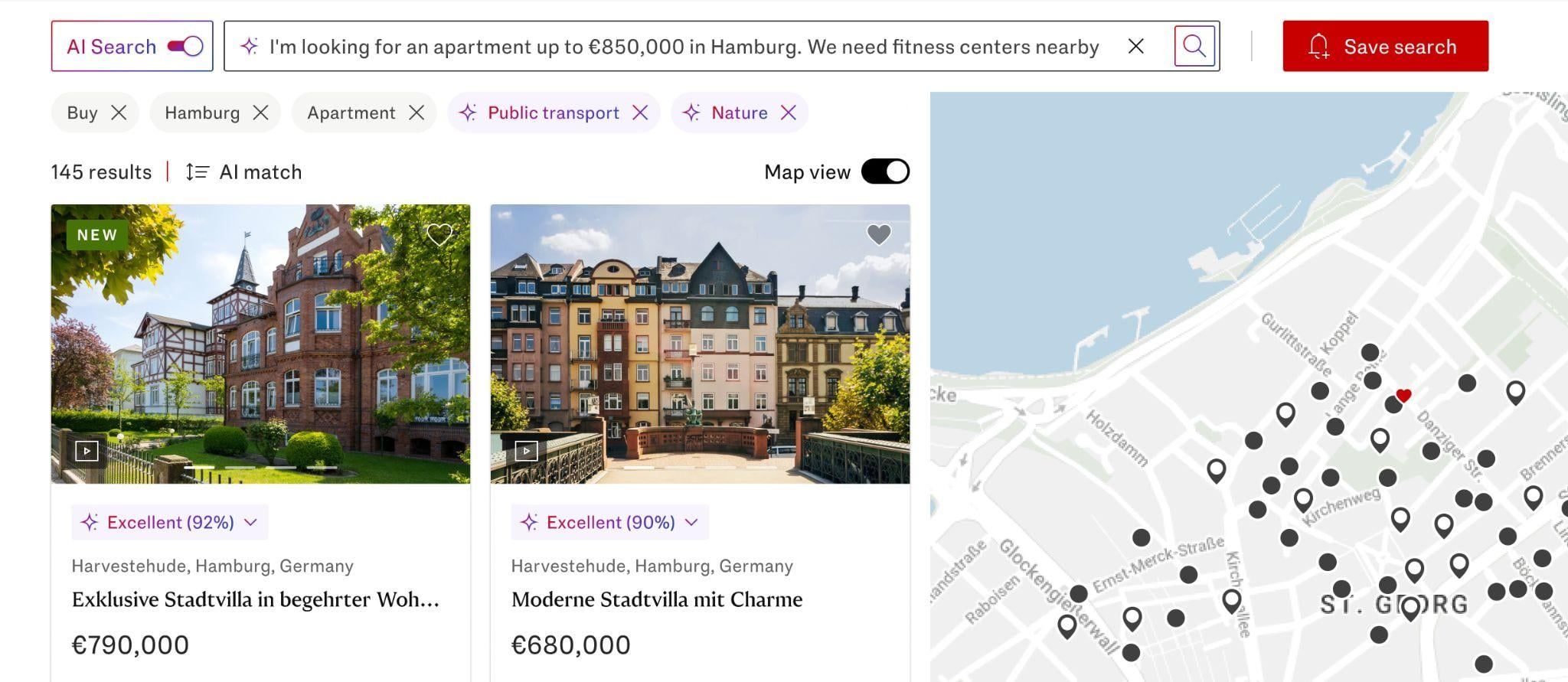
From the query "good schools" and "green neighborhood", both terms are identified and become preferences that are scored and weighed against GeoSci's location evaluations. A budget, if the user names one, becomes a filter that properties either meet or do not.
What the search makes visible
- 1
The interpretation
After every search, users see which filters and preferences the AI recognized, with a short explanation of the difference between filters and preferences. If the interpretation misses the point, they rephrase and search again. The team chose this over letting users edit the AI's interpretation by hand, because a quick, repeatable search proved easier than correcting a structured form.
- 2
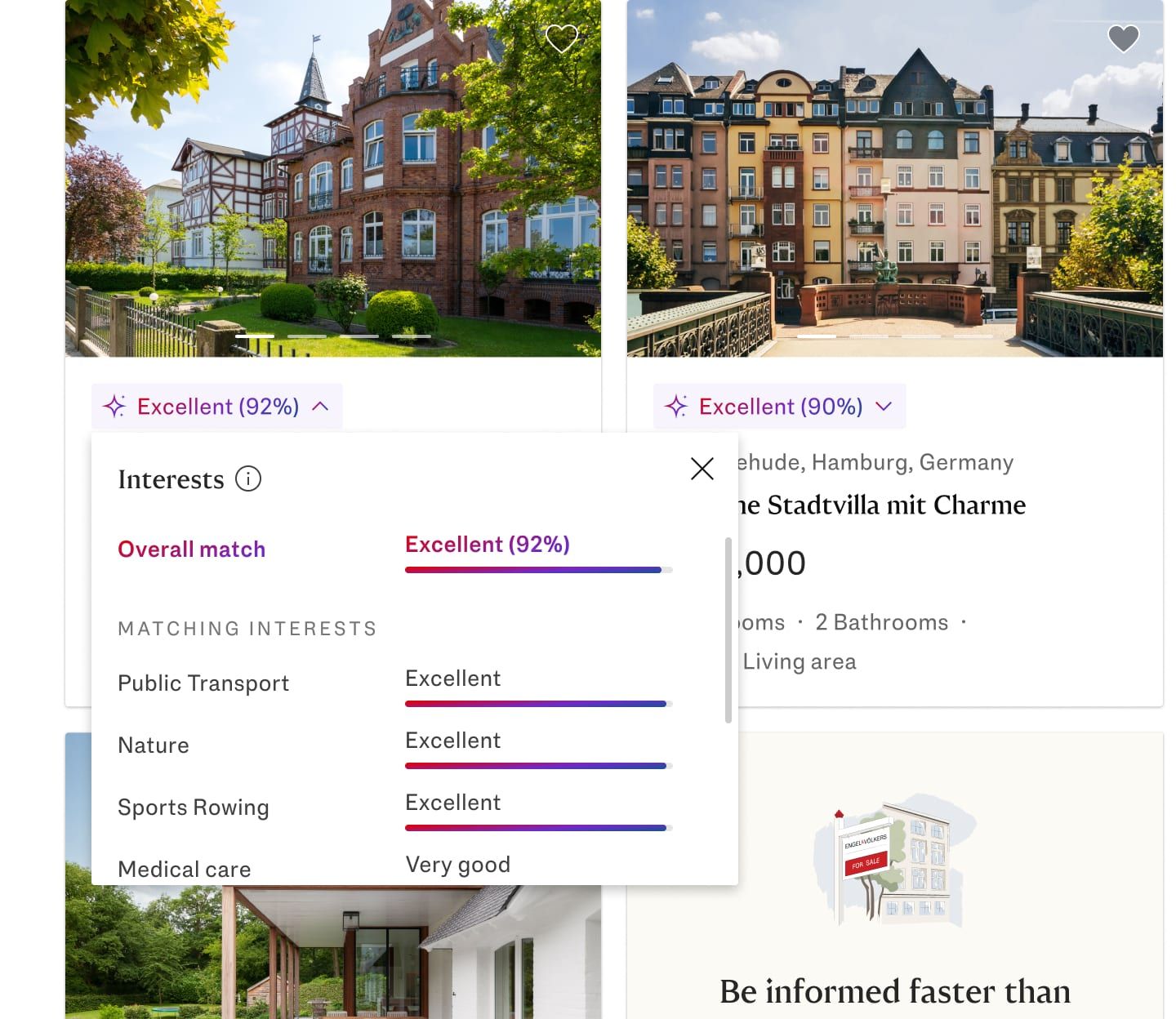
The fit of every result
For every property, users see how well it matches each individual preference. The assessment of personal fit is transparent rather than a black box.
Neighborhoods as searchable data
A property listing describes the property. It often says little about what life around it is like. To answer that, the search draws on approximately 250 location ratings supplied by GeoSci, covering dimensions such as quietness, child-friendliness, access to nature, shopping and public transport. Each rating is a structured assessment of the surroundings that can be matched against a preference alongside the property's own attributes. As if a local expert had carefully enriched each listing with their available knowledge.
What home seekers raise most often in live use
- Nature
- Water, including sailing and boating
- Public transport
- Everyday needs: restaurants, doctors, cinemas, family amenities
GeoSci calculates so many different ratings to enable an AI search with as few limitations as possible. "Sorry, but we don't have the data for your query" should be rare. That means the search can cover very specific wishes, all understood and scored with the same methodology, so Engel & Völkers can serve home seekers with unusual priorities as reliably as those with common ones.
The search understands these too
- A theatre within walking distance
- Quick access to an 18-hole golf course
- A lively restaurant scene
Who built what, and why Engel & Völkers owns the search engine
To make the approach concrete, GeoSci built a complete demonstration application: a property listing site with natural-language query interpretation and a matching algorithm. It translated a request into structured criteria, then matched those criteria against listing attributes and location ratings. GeoSci shared the full code with the Engel & Völkers team as a working reference and a source of implementation ideas. Joint problem-solving sessions then worked through the interpretation approach in Engel & Völkers' own product and technical environment.
Research
Evaluation of the AI searches on the market and research with approximately 30 home seekers.
Reference implementation
A complete demo application: listing site, natural-language interpretation and matching. The full code went to the Engel & Völkers team.
Location intelligence
Approximately 250 location ratings, validated market by market, plus joint problem-solving during implementation.
Search interpretation is a strategic capability, and it belongs to Engel & Völkers.
Both partners agreed on this from the start. GeoSci neither hosts the interpretation engine nor supplies it as a container. The Engel & Völkers team can change and improve the search directly, without waiting for a supplier. And GeoSci is not a dependency in the critical path of every search: it contributes specialist data and expertise while Engel & Völkers fully owns and operates the product.
Spain: validating location intelligence in a new market
After the launch in Germany, Austria and Switzerland, other Engel & Völkers markets quickly started asking to be included in the new search. Before committing to a broader international rollout, the company chose Spain, an important market for its business, to test whether the solution and the location data behind it would work equally well outside the German-speaking countries. We did not want to assume that what works in Hamburg could simply be transferred to Málaga. To find out, GeoSci and Engel & Völkers ran a three-stage validation.
- 1
Assess the source data
GeoSci compared OpenStreetMap and other geographic sources for Spain against DACH: points of interest per inhabitant, minimum and maximum densities, sparsely mapped areas, and the completeness of attributes such as websites, telephone numbers and opening hours. Coverage was less complete than in DACH, but more than sufficient to support the ratings.
- 2
Calculate and inspect the ratings
GeoSci computed the full set of ratings across Spain, compared their distributions with DACH to flag anomalies, inspected heatmaps visually, and ran AI-assisted plausibility checks at approximately 100 locations, comparing each rating against an independently generated reference assessment. Locations were chosen across cities, towns and countryside, with a larger urban share to reflect where people in Spain live.
- 3
Ask the people with local knowledge
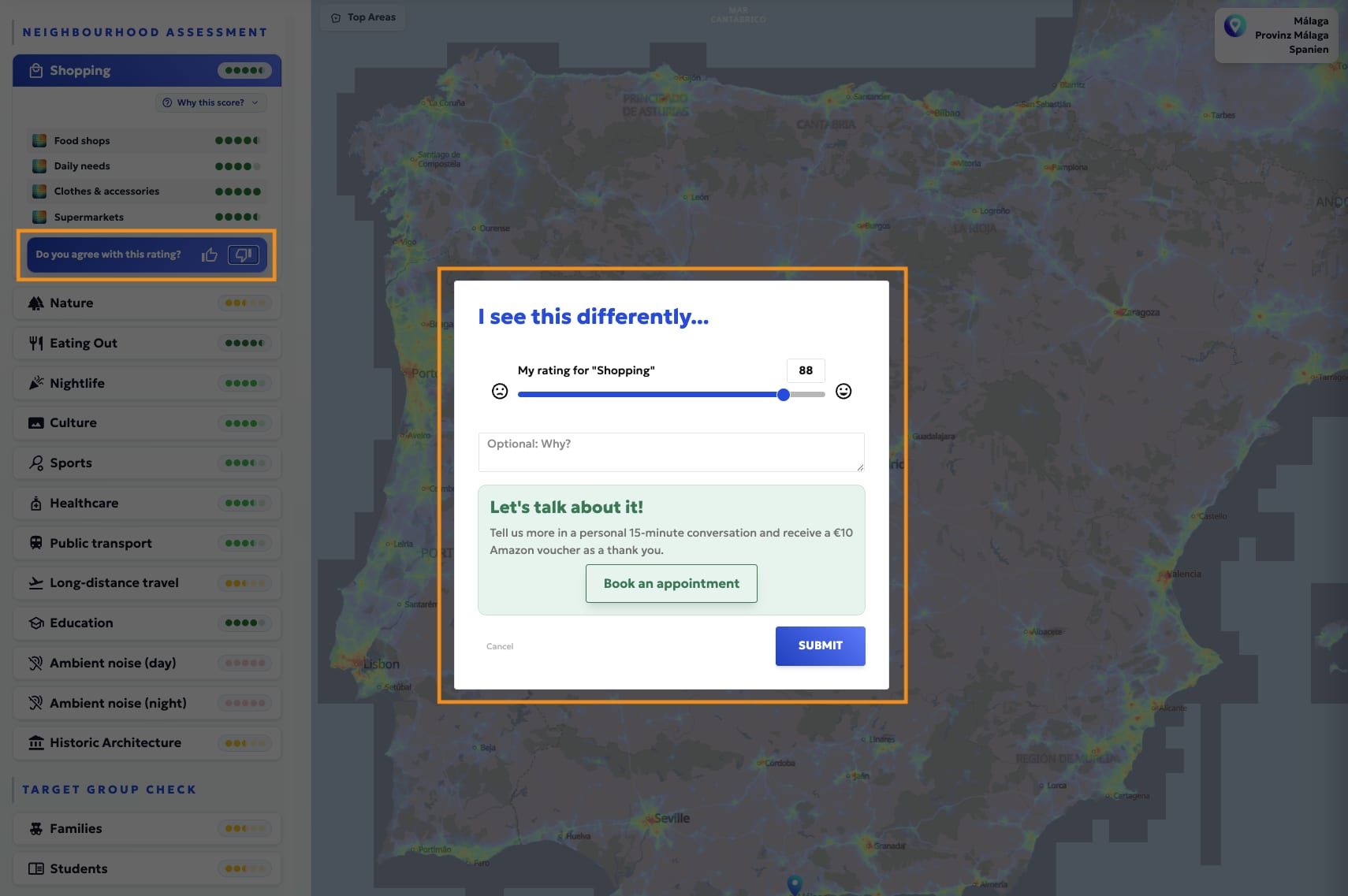
GeoSci brought the new ratings and heatmaps for Spain into our frontend, the Lagecheck. The tool includes a feedback function which connects directly to a GeoSci Slack channel. Local Engel & Völkers experts assessed locations they knew well and reported, rating by rating, whether the score matched their understanding.
Expert assessments, each one rating at one location
Agreement before any adjustment
Agreement after recalibration
Local knowledge became a product improvement
The remaining feedback consisted mostly of smaller disagreements rather than fundamental problems. One pattern did surface: some medium-sized airports were not sufficiently reflected in the international connectedness rating. GeoSci recalibrated the score to give these airports more weight. After the adjustment, agreement rose to around 90%.
The entire go-live process took approximately six weeks. The public search then launched in Spain with the full set of ratings used in DACH.
Results so far
According to Engel & Völkers research from September 2026, users of the AI search submitted property inquiries at approximately twice the rate of users of the classic search.
Where the search stands today
AI search still accounts for a minority of total traffic.
Most prompts map to classic filters such as property type, location, budget and rooms.
Prompts that express lifestyle or location interests already exceed 7%. They are where the AI search adds the clearest value over classic search, and where the location data does its work.
Working with GeoSci has been a consistently positive experience. Direct communication and quick alignment between GeoSci and our internal team have helped to achieve the best possible results. As AI becomes an increasingly integral part of everyone's daily life, expanding AI search into more countries will help us lead the way and prepare confidently for what's ahead.
Isabel Moning, Lead Product Manager, Engel & Völkers
What comes next
A phased rollout across further Engel & Völkers countries is planned to begin in early 2027, with Italy currently the likely next market. The Spain validation now serves as the template for each new country: assess the data, calculate and inspect the ratings, and check them with the people who know the places.
The priorities for the rollout: the search must perform particularly well on the location themes users care about most, above all nature, water and public transport. In general, we are jointly working on including more location ratings to make sure the search can answer any question home seekers may ask.
The takeaway for property platforms
The project shows a good division of labor. The platform owns the search and the user insights that come with it. A specialist partner contributes the research, the reference implementation and the location intelligence that lets the search understand neighborhoods, and validates that intelligence market by market.
AI search for your platform?
Let us talk about how location-aware search could work for your portal.